
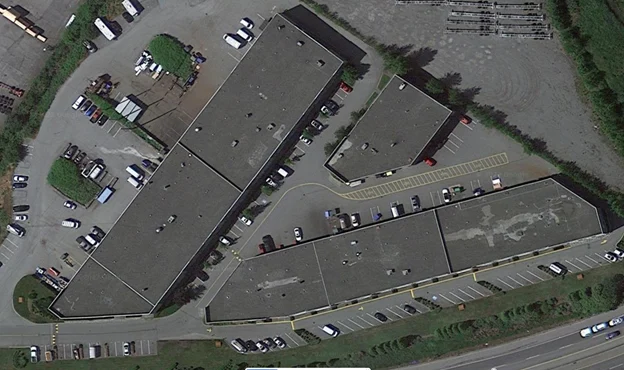
Rob’s electronic component rep business is headquartered in a shared complex of two-story industrial bays.
In the fall of 2020, Mo, whose business is in the bay next to Rob’s, came to him with a tale of woe. The trailer he keeps behind his bay had been broken into. Tens of thousands of dollars in tools and material had been stolen.
This was a surprise as their complex has gates, cameras, and security patrols. Mo browsed through the security camera footage and found the culprit arriving on a Sunday morning at 4 AM. The perpetrator tried the side door first, then moved to the rear double doors. It took him 45 minutes to break into the trailer. Seriously, it took that long to break in!
Rob asked why the trailer wasn’t alarmed and Mo replied, “I’m not sure it’s possible.”
Upon further investigation Rob determined that, because the trailer is mobile, it doesn’t have power or Wi-Fi connections, since those provisions aren’t possible when the trailer is moved from home base.
Next, Rob checked with Steve Todd, whose Stealth Security company provides the alarm systems for their industrial complex. Sure enough, Steve confirmed that there were no alarm systems on the market that would work because the trailer was mobile and had no power.
Moreover, Rob lives in a neighbourhood where old houses are being torn down and new luxury homes are being built. Here too, Rob discovered, break-ins into construction tool trailers by thieves was a common occurrence.
Sensing a business opportunity, Rob got a flash of inspiration. If he could just figure out how to wirelessly connect a small, portable, battery-operated device with intrusion sensors to the internet, there should be a market for it.
The first idea was to adapt a trail camera, used by hunters and field biologists to automatically capture images of wildlife in their habitat. Such cameras are triggered by passive infrared motion detectors and can capture still images or video. However, they only record images for inspection later. There is no real-time notification that the device has been triggered. By the time someone got to downloading the images from the camera, the thieves would be long gone, probably taking the camera with them.
Another problem with the trail camera idea was that these cameras are very power hungry. The remote camera Rob checked needed 8 AA batteries to power it for up to a couple of weeks at best.
At this point Rob turned to his friend and long-time customer, John Turner, an experienced RF engineer with his own design and consulting company, Valhalla. The two of them initially thought they might be able to modify the trail camera to use less power. However, getting real-time notice of a break-in was still a problem.
At this point, John suggested they rethink the problem and start from scratch.
Meanwhile, the whole 5G LTE Internet of Things (IoT) technology was getting off the ground. This technology is specially designed to be extremely low power and to use the 4G and 5G cellular networks as a gateway to the internet. Major cellular carriers were starting to build out their networks with the necessary 5G IoT infrastructure.
Furthermore, low-cost chipsets from companies like Nordic Semiconductor and Quectel were coming on the market, making it relatively easy to implement a small, reasonably priced device that could stay alive for years on 4 AA batteries.
With an experienced RF designer on board, Rob then recruited Jack Woida for his broad business background in the tech industry, and Jason Hennig for his software expertise.
The team now has a working prototype that includes a cellular modem for connecting to the 5G IoT network. Users can communicate with the device remotely over the cellular network, or locally using either Bluetooth, a USB port, or NFC reader capability.
The device is triggered by onboard sensors that include a microphone as well as an accelerometer, both of which are used to detect the noise and vibration of an intrusion attempt. The device includes inputs where the user can connect door switches, which will trigger if a door is compromised. There’s also a GPS receiver on board, which is triggered to take a fix if the trailer is moved, and then tracks the trailer on an ongoing basis.
All this data is immediately transmitted over the 5G network to a cloud-based data collection site and then communicated either to the security monitoring company or to the end user. There is also SMS messaging capability so that an alert can be sent to the end user's cellphone.
That is the story of the business idea behind Remote IoT Security Ltd. We look forward to helping businesses secure their movable property on construction sites and to learning about other use cases that may emerge over time.